
One of the major reasons people read books about stress is to learn how to decrease the stress in their lives. According to a new book by famed Stanford Psychologist Kelly McGonigal this idea of stress mitigation is a VERY bad idea.
This Upside of Stress review is the first in a new series of Develop Good Habits book reviews. Every Saturday will bring a new self-help/positive psychology book review.
McGonigal, is the author of one of my favorite books “The Willpower Instinct”. In that book she discusses how willpower can be used to improve productivity, health and happiness. In my opinion, Willpower Instinct is easily one of the best books ever written on the subject of willpower. (Along with Baumister’s classic book “Willpower”)
“Willpower Instinct” did provide some clues on her opinion of stress, long before she wrote this new book. In it she showed how stress can derail willpower. But also how the brain can be trained to higher levels of willpower afterwards. The classic example is to think of willpower as a muscle and stress as a heavy weight. The weight of stress will hurt and tire you out, but it will also slowly build the willpower muscle.
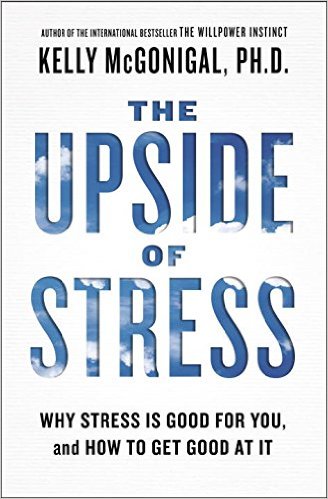
Get your copy of “The Upside of Stress” today!
In the “Upside of Stress”, McGonigal turns the common perceptions of stress on its head. The key message of this book is that stress can be good for you. It is not stress itself that is bad, but people’s reaction to stress that is bad. Approach stress positively and it can use it as a tool for growth. Constant pressure makes someone sick, not from the stress itself, but from the worry about stress.
Another major point McGonigal brings up in her book is resilience. Resilience, according to McGonigal, is the measure of how much stress different people can take.
Takeaways from the “Upside of Stress”:
Someone who lives through high-pressure situations while young is likely to be quite resilient. They will compare all stressful situations to their past and find it lacking in comparison. They will roll with the punches and view stress as a natural part of life, not something to be avoided.
In, the “Upside of Stress”, McGonigal uses examples of many experiments done over the past 20 years to back up her key points.
One of the interesting experiments was done by Harvard professor Alison Wood Brooks.
Before an important speech one group of students were told to repeat the mantra of, “I am excited”. The second group was told to calm down their nerves by repeating, “I am calm”
The results were quite clear. The “I am excited” group did much better. They embraced the possibilities of the stress of the speech and positive outcomes and were rated significantly higher than the other group. The second group that tried to control their stress with the, “I am calm” mantra, may have felt calmer, but their performance was subpar.
This shows that it may not be best to avoid stress and anxiety. It is far better to take those powerful feelings and channel them into something useful.
People who live lives avoiding stress are more likely to view challenges as “too tough” and just quit. While people who are used to stress, will see the upside of a bad situation. An example of this being people who have had a heart attack. Some use the experience to change priorities in their life and appreciate their second chance. While others may concentrate on the stress of their possible impending doom.
The best approach to stress may not be avoidance or mitigation, but using it a lesson today to help us grow our resilience for tomorrow.

If you are looking for stress relief, this book may run counter to what you want to read. McGonigal, however, lays out a very compelling argument. You would be doing yourself a disservice if you did not take her points into consideration when thinking about how to handle your stress. It might not be the problem you think it is.
Want more books on dealing with stress? Check out the stress book review page.
Rather than letting stress eat you alive, why not try using it to achieve greater success.
Get your copy of “The Upside of Stress” today!
Want even more self-help book suggestions? Check out the 250+ best self help books page.